Wednesday, April 11, 2012

April 8, 2012 - Easter Sunrise Service - What Do We Make of An Empty Tomb?


April 8, 2012
Mark 16:1-8
Sunrise Service

What Do We Make of An Empty Tomb?

In the days prior to Easter I’m always curious to see what bookstores are offering.  Most years there are a number of books and magazines about Jesus in the days before Easter.  This year it was a bit different, as there didn't seem to be as many titles about Jesus.  In fact, it seemed there were more magazines about UK and their national title season than about Jesus.

The resurrection is a great dividing line.  It is a dividing line between faith and skepticism, between belief and doubt – it is a dividing line over how to view the world, history, the past, the present, the future, and ourselves.

We ended our reading from Mark’s gospel at the point when Mark says they said nothing to anyone, because they were afraid.  That seems like an odd point to end the reading, but it leaves us at the point of so many of the early followers of Jesus – what do we make of an empty tomb?  Most of the followers of Jesus had no other information other than word of an empty tomb.  Very few actually saw the empty tomb, so they were left with the question – what to make of an empty tomb?

We are the beneficiaries of 2,000 years of history, theology, and teaching about the resurrection.  Belief in the resurrection and the understanding of the resurrection as the pivotal event in human history is passed on from one generation to another almost as though it is a family heirloom.

Though Jesus spoke of resurrection, his followers didn’t really expect it, and had a hard time believing it was true, as the resurrection narratives in Scripture clearly show.

How do you comprehend something that is so completely outside your range of knowledge, experience, or expectation?  How do we, to use today’s overused language – think outside the box our minds have been molded into?  How do we accept the impossible as possible, and the implausible as plausible?

Because of faith.

It was faith, awakened in the early followers of Jesus by the resurrection that completely transformed their lives.  How else could this small band of followers, frightened and confused, have gone on to transform the world?

What do we make of an empty tomb?

There is a spiritual side of life.  I was in a bookstore yesterday and picked up a book from a table featuring titles for Easter.  One of the books was from the point of view of unbelief.  I thumbed through it and it was the same old stuff, and what struck me was a touch of sadness because of the inability to see that life is more than the material – more than what can be touched, or seen, or measured in a laboratory.  There is a spiritual side to life.  We are more than flesh and blood, and the resurrection challenges us to remember there is more to life than just making a living and pursuing entertainment.

There is a new beginning for life.  John’s gospel points out that the resurrection takes place on the first day of the week.  That’s much more than just a simple observation – it is a reflection back to the book of Genesis and creation.  This is a new creation.  The resurrection remakes everything.  And the great promise of the resurrection is we get a new beginning.

Like many of you, I have a Facebook page, but I wonder sometimes if it’s a good idea.  And I’m amazed at what some people put on their Facebook page.  Those pictures and comments follow people forever – it guarantees you can’t escape your past.  People like to bring up our past to us sometimes, but the resurrection means we have a new beginning.

It also means God’s great love is poured out on all people.  About ten years ago I was in Wilmore for the Ichthus music festival.  On Saturday evening they have a huge outdoor communion service – over 20,000 people in this large field – and on that particular day an interesting cloud formation floated over the crowd.  As the communion service began, a cloud formed in the shape of a perfect cross began to float overhead.  It gradually moved across the sky, from one end of the field to the other, and the timing was perfect as it dissipated just at the end of the time of communion after passing over the entire crowd.
It was a really great effect to see this cross in the sky passing over this large crowd of believers sharing a tine of communion together.  I think about that moment occasionally, and the idea of the cross covering the world is a very powerful image.

Here is a very important truth – Jesus lived, died and rose for all people.  The life, death and resurrection of Jesus was not just for you and me; it was not just for people who believe; it was not just for church people – the life, death and resurrection of Jesus was for every person alive at the time and for every person throughout history.  The power of the cross and what the cross of Jesus accomplished covers all people, not just some.

What do we make of an empty tomb?  Life, hope, and love, because of the resurrection of Jesus.


April 5, 2012 Maundy Thursday - A Vision to Bind Us Together


April 5, 2012
John 15:9-17

Maundy Thursday
A Vision to Bind Us Together

It would be quite an understatement to say that humanity struggles with division.

Sometimes it is hard to remain bound together as we walk in faith.  This evening, on Maundy Thursday, we come to remember the Last Supper of Jesus and his disciples.  In John’s telling of the Last Supper, Jesus offers A Vision to Bind Us Together.

John’s telling of the Last Supper covers five chapters (chapters 13 – 17) of his gospel, the longest continual story in any of the four gospels.  The words of Jesus in this passage of Scripture contains his words a new command I give to you:  Love one another.  As I have loved you, so you must love one another (13:34), which is the verse that gives us the name for Maundy Thursday – novum mandatum, or new commandment.

This is the vision Jesus gives to bind us together – love.  Love was the foundation of everything Jesus said and did, and it was love that bound him to the cross.  And it was his vision of love that bound together the disciples, a group that under normal circumstances would neither come together or be able to remain bound together.

As a group, the disciples were so different it would take a powerful vision to hold them together.  There was Simon, very much a stranger to us.  We do know he was a Zealot – one who was dedicated to the overthrow of Roman rule by any means necessary.  Zealots hated the Romans.  Matthew, who is more familiar to us, was a tax collector, which meant he worked for the Romans.  How could Simon and Matthew walk together in this small band of followers of Jesus?  Because they had a greater vision, a vision that bound them together, a vision of love.  There was Peter, Andrew, James, and John, who were fishermen, and thus small businessmen.  Perhaps Matthew was the one who collected their taxes.  If not, they certainly resented what he represented as one who could tax them at almost any rate of his own choosing.  The others may have been jealous or envious of the favored position of Peter, Andrew, James, and John.  They are clearly the dominant members of the disciples, and of this inside group Peter is clearly the leader.  Perhaps there was jealousy of his important role.  Judas was known to take money from the moneybag held by the disciples (John 12:6), and it seemed to be an open secret, so this was surely a source of division among the group.  James and John, on more than one occasion, asked Jesus for a place of preference in his kingdom (Mark 10:35-45), which did not sit well with the other disciples.  Mark (10:41) tells us the other disciples were indignant about their grab for power.  But it wasn’t just James and John.  On at least one occasion (Luke 9:46) the disciples as a group argued among themselves as to which of them would be the greatest.

But though we read of these conflicts, they are mentioned only a few times.  Considering the dramatic differences and divisions among the disciples, it is quite amazing we don’t read of them more often.  The answer as to why the differences aren’t mentioned more, I believe, is very simple – in spite of the differences and in spite of the conflicts between the disciples there was a greater vision that bound them together.  It was the vision Jesus gave of love.  Jesus’ vision of love was one great enough to unite the disparate band of followers and remains the great vision that unites us today. 

In our broken and divided world, the vision of love is still the answer that is needed.  Love is powerful enough to bridge the divides among humanity, it is strong enough to heal divisions, and it is what is represented by these elements this evening.

Monday, April 02, 2012

April 1, 2012 - Ancient Stories and Timeless Truths: Be Careful What You Wish For


Some years ago, in another community, we had a group of churches that would gather occasionally for community services.  On one occasion our church was hosting, but another minister was responsible for the message.  He called me during a few days before the service and said, there’s a guy running for statewide office and I asked him to come and speak.  He’s promised not to give us a campaign speech.  Is that okay with you?  I asked, are you sure it’s not going to be a campaign speech?  Oh no, the other minister said, he’s promised me.  Against my better judgment, I said, okay.  Guess what we got that night – a campaign speech.  The people who agreed with his politics liked it and those who disagreed with his politics didn’t like it.  And I wondered how I walked right into that mess.

Political power and spiritual power have always been like oil and water – they just don’t mix very well.  We are citizens of two kingdoms – we are citizens of an earthly kingdom and a spiritual kingdom, and they do not always mix in our own lives very well. 

Today, on Palm Sunday, we remember the entrance of Jesus into Jerusalem, but I want us to examine Palm Sunday in light of an Old Testament text, since we have been traveling through the Old Testament in recent weeks.

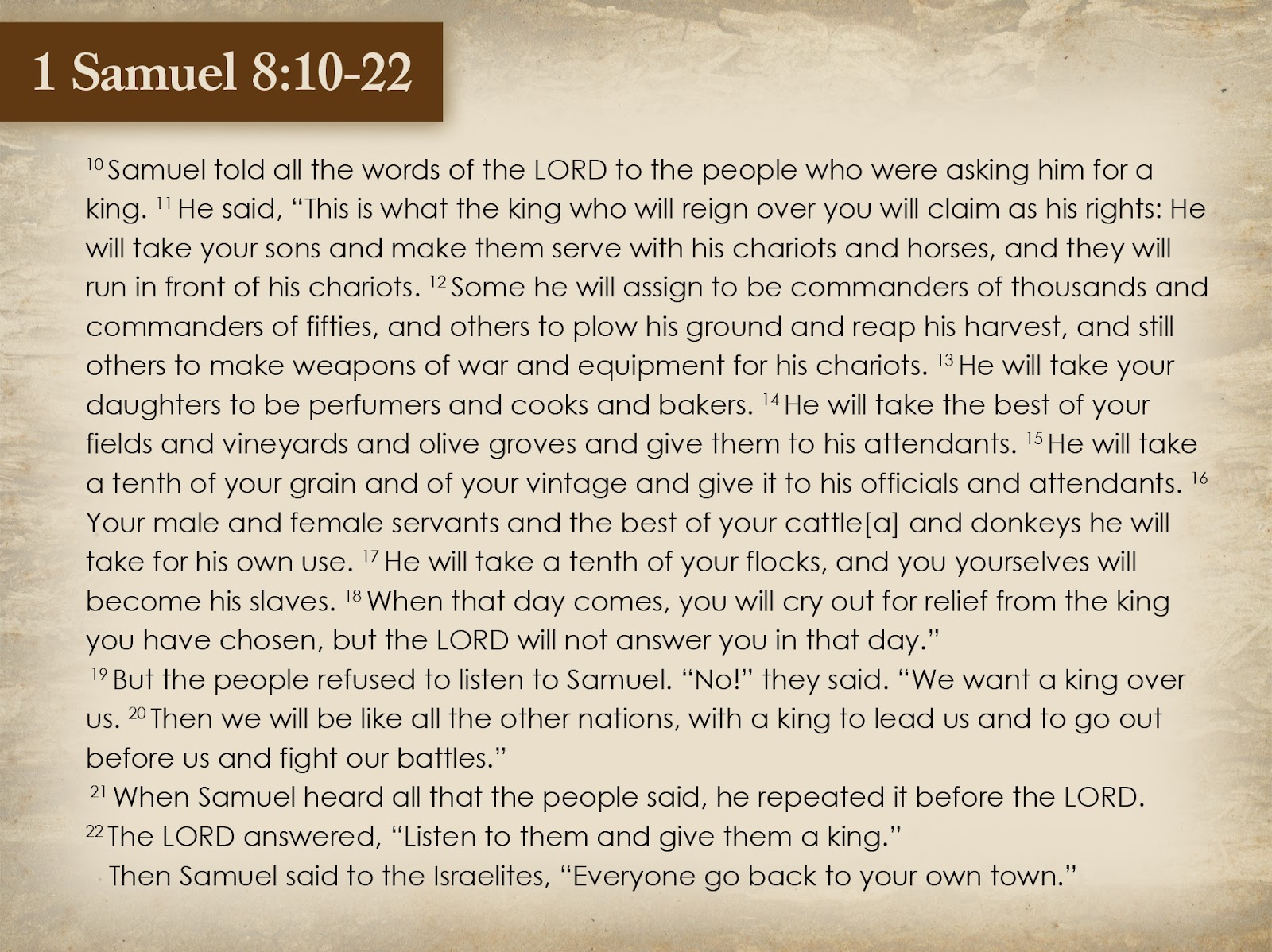
Our text today comes from I Samuel.  It’s a passage that is, I think, a parallel passage to the Triumphal Entry found in the gospels.  It is a text that reminds us that the two kingdoms – earthly and spiritual – have very different goals and agendas.

In this passage, and the passages that tell us of the Triumphal Entry, we see the same desire by the people – the desire for a political savior.  Just as the crowd cheered Jesus in large part because they were hoping he would be a political savior, the people of Israel wanted a king – a political savior.
Jesus was not interested in picking up the mantel of political messiah, and Samuel was not interested in anointing a king for the nation of Israel.  Both were well aware of the dangers in what the people were seeking, and they are dangers we would do well to avoid as well.

Power is intoxicating, and corrupting. 
I vividly remember the first trip my family took to Washington, DC.  One of the reasons I remember it so well is because I didn’t want to go.  I had always heard that Washington is one of those places everyone should visit at least once during their lifetime, but my feeling was, why can’t we go to the beach?  Why Washington? Unfortunately, I did my best to make my displeasure known about the trip.  Driving to Washington we traveled through West Virginia, and I couldn’t help but say, all I wanted to do was get out of these mountains and here we are driving through them – and on our way to Washington.  We were going to stay with my brother-in-law and his family and thankfully, I resisted the temptation to complain about that arrangement.  After arriving at my brother-in-laws house and settling in for the evening, we set out the next morning for the train station and our journey into the city.  We couldn’t find a parking place at the train station and once again I suggested we should go to the beach.  Finally, after finding a parking spot, we started our walk to the station and it started raining on us.  After riding the train into the city we arrived at the station by Capitol Hill.  We walked up the steps and right at the top of the steps were two senators talking.  Then we went into the Capitol, and into the galleries, and all of a sudden, I was hooked like a fish who never saw the hook coming.  I was so caught up in what I saw in Washington and thought, so this is how it happens.  You get around power and get caught up in it.  It really is intoxicating and addicting.

And that’s one of the dangers of power.  It leads us to believe that it has an answer to every issue and a solution to every problem and if we can just get our hands on some of that power we can fix everything that’s wrong with the world.

But it never seems to work out that way.

Jesus saw the corrupting nature of power.  After his entrance into Jerusalem he entered the Temple and began knocking over tables and driving out the merchants and the moneychangers and he was not a bit gentle in doing so.  John’s gospel tells us that Jesus fashioned a whip out of some cords (John 2:15), and as he did I can imagine what was going through his heart and mind – heartbreak at seeing the Temple reduced to a place of dishonest and exploitive commerce and a place where the religious leaders were in league with the Romans to exploit people for their own selfish gain. 

Earthly and spiritual kingdoms do not mix very well.
Lora finds a lot of great pictures for my messages, and I appreciate the great amount of time and effort she offers.  This is one of my favorites of all the pictures she has sent to me.  What a contrast in this picture – a crown of gold and jewels with a crown of thorns.

It is a very stark reminder of the opposing goals of an earthly kingdom and a spiritual kingdom.  An earthly kingdom is about ownership and power to enforce an agenda; a spiritual kingdom is about humility and the giving up of power in sacrificial service; an earthly kingdom will use force when necessary; a spiritual kingdom turns the other cheek; an earthly kingdom is often based on self-interest; a spiritual kingdom is about the giving up of self-interest for the interest of others.  In fact, the words of Paul in Philippians 2:1-11 is the best way of defining the contrast of the two kingdoms – Therefore if you have any encouragement from being united with Christ, if any comfort from his love, if any common sharing in the Spirit, if any tenderness and compassion,
then make my joy complete by being like-minded, having the same love, being one in spirit and of one mind.
Do nothing out of selfish ambition or vain conceit. Rather, in humility value others above yourselves,
not looking to your own interests but each of you to the interests of the others.
In your relationships with one another, have the same mindset as Christ Jesus:
Who, being in very nature God, did not consider equality with God something to be used to his own advantage; 

rather, he made himself nothing by taking the very nature of a servant, being made in human likeness.
And being found in appearance as a man, he humbled himself by becoming obedient to death—even death on a cross!
Therefore God exalted him to the highest place and gave him the name that is above every name, 

that at the name of Jesus every knee should bow, in heaven and on earth and under the earth, 

and every tongue acknowledge that Jesus Christ is Lord, to the glory of God the Father.

That is the Magna Carta, the Declaration of Independence, the Bill or Rights, and the Constitution of a spiritual kingdom.

The power of love is the greatest power.
The Triumphal Entry of Jesus was not the only entrance into Jerusalem that drew a large crowd.  Probably just days before, Pilate would have entered Jerusalem, but not on a humble donkey.  Pilate entered Jerusalem on a war horse, surrounded by all the trappings of Roman power.  But most people have no idea about that entry, and it’s because of the primary difference between Pilate and Jesus – Pilate was about a temporal power, a power of this earth that could compel people to do what Pilate wanted done, but Jesus had the power of love, and there is no greater power.

Some years ago, a friend of mine traveled to a part of the world where followers of Jesus face a great deal of persecution.  He was part of a group of businessmen who went to give business advice, but also in hopes of strengthening members of the underground church.  He met a man who owned a small business and was also a Christian.  Because of his faith, his business was burglarized and vandalized and he was beaten and arrested on several occasions.  In spite of the persecution he faced, he continued in his faith.  How was he able to persevere?  Because the power of love is the greatest power.  The power of love was greater than the might of the Roman Empire that crucified Jesus.  The power of love is mightier than the hatred and the violence that is in our world.  Earthly kingdoms came and go, but the power of love demonstrated by God’s kingdom lasts forever.


Monday, March 19, 2012

March 18, 2012 - Ancient Stories and Timeless Truths: The Importance of the Minority Report


Numbers 13:26-32


Living in a democracy, we are very familiar with the principle that the majority rules.  The good news of democracy is that we have a vote; the bad news of democracy is that sometimes our vote goes to the losing side. 

But democracy also has a strong tradition of the dissenting minority.  Even when we lose, it is our right to say what we believe and to praise or criticize the winning candidates.  It’s a wonderful part of democracy that the minority opinion is allowed free expression. 

This is a time-honored tradition, for example, at the Supreme Court, where those who hold to the minority opinion can give a blistering dissent, and where time sometimes proves the minority opinion to be the correct one.  John Marshall Harlan was an associate justice of the Supreme Court.  A Kentuckian, he was born in Boyle County, attended Centre College and went to law school at Transylvania University.  In 1896 he wrote the sole dissenting opinion in a case that established the separate but equal principle.  Harlan wrote, in view of the Constitution, in the eye of the law, there is in this country no superior class of citizens. There is no caste here. Our Constitution is color-blind, and neither knows nor tolerates classes among citizens. In respect of civil rights, all citizens are equal before the law.  Even though his was the only dissenting opinion when the ruling was handed down, time has certainly proved that Harlan’s opinion was the correct one.

Scripture also has some minority reports, and today’s message comes from one.

Moses and the Hebrew people were in their second year after being released from slavery in Egypt (9:1).  It had not been an easy journey for them to this point.  Time after time they faced difficult challenges and again and again the people struggled to trust and to have faith.  After the months of difficult travel, after many conflicts, and after much complaining, they arrive at the edge of the Promised Land. It had been many generations since Abraham had received the promise, and now his descendants are so close.  It had been about four centuries since God first made his promise to Abraham, so imagine the anticipation in this moment.  Centuries of waiting are about to come to an end.

Before they would enter the land Moses has everyone wait while he sends twelve spies into the land to check it out.  He instructs the spies to determine if the people living in the land are strong or weak, if they are few or many, if the land is good or bad, whether or not the cities are heavily fortified, to see if the land is productive, and to bring back some of the fruit of the land (13:18-20).

Notice this is not the same story we usually think of when it comes to spies being sent into the land.  That story comes later in the book of Joshua, when there are only two spies and those two spies were given shelter by Rahab.  The episode we’re studying this morning takes place thirty-eight years before the event recorded in Joshua.

When the spies return from their forty-day mission and give their report it is a good news/bad news report.  They tell Moses and the people that it is indeed a land flowing with milk and honey and showed the fruit they brought back with them.  The grapes they brought with them are so large they had to carry just one bunch on a pole between two of the men.  The land is rich, productive – all the things they could hope for.  That’s the good news. The bad news then takes the rest of the report, and the news is really bad.  The people in the land, they report, are very strong.  The cities are very large and fortified and the people are as giants.  There is no way, in the opinion of these spies, that the inhabitants of this land could be defeated.

But then Caleb and Joshua offer the minority report, and it reminds us how important it is that we hear the minority reports in life, those words spoken that go against the grain of the accepted wisdom of the time, a wisdom that time sometimes proves as not being wisdom at all.

The Sermon On the Mount is another minority report.  In the Sermon On the Mount, which we studied last year, Jesus spoke against many of the accepted opinions of his day.  He challenged people’s thinking and attitudes in very powerful and necessary ways.

I believe that as followers of Jesus we are called to be the minority report in our world; we are to be the dissenting voice that speaks for the will of God.  I want to take a few minutes this morning and talk about four ways in which we need to be the minority report in today’s world.

I feel that I must also add a disclaimer.  In our world, where everything is seen in such a political context, my words are not meant in a partisan way.  I believe there are issues we must address and they do not have to sink to the level of partisanship.  Talking about issues, especially those that have political implications, is not partisanship.  Partisanship is when we discuss the particulars of how we are going to address an issue and who is going to lead us there.

1.  Relationships.
We must learn how to talk to one another in our society.  The level to which we have sunk in our public discourse in this country is very discouraging.

I wrote about this in my most recent Cup article so I don’t want to retread what I said there, but I do want to add a few words to that article.  When people resort to the kind of name-calling we are now witnessing, something is very wrong.  People engage in name-calling that would have resulted in many of us having a mouthful of soap when we were kids, and these are influential adults!  I don’t like the name-calling of Rush Limbaugh, but I don’t like the name-calling of Bill Maher either.  I don’t care what a person’s political or religious perspective may be, when you resort to calling people names it is only evidence that you are completely lacking in the needed imagination to make your point.

We are also called to be the minority report between societies.  We live in a very dangerous world, and I believe we must have something to say about when and how military power is used.  I will admit that I have a gap in my own thinking I can’t quite put together – I believe Jesus was a pacifist, but I am not, and I have to ask why I am not.

I believe military force is a political action, but a spiritual voice must speak to the question of military force.  It is such a huge decision to send our men and women into harm’s way, and we must bring to the conversation some important questions to consider.  The men and women who serve are willing to risk their lives, and some of them give their lives.  Many of them suffer from wounds or other difficulties of war and we must advocate on their behalf that they receive the care they are due.  But we must also remind our leaders there are civilians who will end up in the middle of war zones, and their lives also matter.

2.  The environment.
I grew up in West Virginia, in the northern panhandle.  My hometown of Wellsburg sits in the midst of steel and coal country.  In that part of the country, the Ohio River was so polluted it caught fire.  It is a strange thing to watch a river burn.  But we didn’t use the word pollution; we used a different word – paydirt.  We called it paydirt because the pollution represented many jobs and a booming economy.  When the skies cleared, it meant the economy was faltering.

God has given us a beautiful world that we are destroying, and too often the church doesn’t say much about it.  We’ve got to remind people that it’s not just an economy that we pass on to our children and our grandchildren, but a world as well.  We are stewards, not owners of this world.  This world belongs to God, and we are given charge of caring for it.
Wendell Berry says that we have mastered the art of thinking big but it is now necessary to master the art of thinking small, that is, considering the role each of us have in caring for and protecting the world God has entrusted to us – not given us, but entrusted to us.

3.  Freedom.
There is an undeniable connection between the gospel and human freedom.  We ought to be advocating on behalf of all people for freedom.  As followers of Jesus we ought to be the first ones to say that the people of Syria ought to be free, that no people should have to live under tyranny. 

Jesus lived under the rule of Rome.  It was Rome that crucified him.  It was Rome that persecuted the church.  But the church outlasted the Roman Empire, because the desire to be free will overcome tyranny, because God planted the desire for freedom in the human heart.

If you read history you find it was the church that said people should not live under slavery.  Yes, there were those Christians who were in support of slavery, but the opposition to it came from within the church.  It was the church that birthed the movement for equal rights.  The leaders of the civil rights movement were mostly ministers.

4.  Fairness.
It’s easy to look around the world and find a lot of unfairness. 

The gospel calls upon us to advocate for fairness to all people.  We must be the ones to say that society cannot be structured to favor the rich and to work against the poor.

We often talk about how some things that happen in the world are because that’s just the way things are, as though we should accept the way things are.  We are not called to accept things the way they are when it means some people are not given equal rights or people are treated unfairly.  We are called to be the dissenting voice – the minority voice – that will speak for those who are treated unfairly.

There are many people who are uneasy about the direction of our society, fearing that the church is losing its influence.  I happen to believe there are some positives in this trend.  Maybe we have spoken too long from a position of power, when we need to speak from a position of love.  The early church spoke from the margins of society, not from the echelons of power.  Our voice may be stronger when it comes from the margins of society rather than from its centers of power. 

But the larger question will be – how will history look upon us?  Will we be the dissenting voice, the voice eventually proven to be correct, or will we be content in the majority, and allow history to judge us as being wrong.


Monday, March 12, 2012

March 11, 2012 - Ancient Stories and Timeless Truths: Making God Easy


Exodus 32:15-24


I have with me this morning a box of Hamburger Helper.  How many of you believe that mixing up some of this and putting it in the oven will result in a gourmet meal?  I don’t think anyone will confuse this with a gourmet meal.  What’s the purpose of this kind of product?  It’s to make life easy, isn’t it?  Life is busy, so why not find a shortcut, a way to make life easier?  The convenience is nice, but it will never compete with the real thing – a home cooked meal of high quality.

For various reasons, we accept a lot of things in life that are much like this box – nothing more than a pale imitation of the realities they are supposed to represent.  We accept them because they are easier. 

We do the same thing with God.  We find ways to make God easy, because God is not always easy.  God is easy when we consider the many gifts he brings to our lives, but God is not easy when we begin talking about loving our enemies, praying for our persecutors, carrying our crosses, and the other great challenges God sets before us.

As we continue our series Ancient Stories and Timeless Truths, we come to a passage that takes place during the journey of Moses and the Hebrew people to the Promised Land.  It is a story of people trying to make God easy.  The story takes place as Moses is on Mount Sinai.  He is on the mountain receiving all that will become the religious and legal framework for the nation of Israel.

We’ll pick up the story at the beginning of chapter 32.  Exodus tells us when the people saw that Moses delayed to come down from the mountain, the people assembled about Aaron, and said to him, “Come, make us a god who will go before us; as for this Moses, the man who brought us up from the land of Egypt, we do not know what has become of him.

It’s important to remember that before Moses climbed the mountain he brought all the people together in a service of consecration (chapter 19).  Exodus tells us that a thick cloud and thunder and lightning enveloped the mountain and all the people in the camp trembled at the realization of God’s presence on the mountain (19:16).  God confers with Moses and then Moses comes down the mountain to report to the people.  He tells them all that God has said and 24:3 reports that all the people answered with one voice, and said, “All the words which the Lord has spoken we will do!”  In verse 7 they make the same affirmation.  Moses then goes back up the mountain, this time taking Joshua with him, and he leaves Aaron in charge.  On the second trip Moses was on the mountain for forty days and forty nights (24:18) and the presence of God on the mountain was visible to the people because it appeared that there was a consuming fire on the mountain top (24:17).

Then it gets hard.

The people get tired of waiting on Moses and approach Aaron and ask him to make for them another god.  The people say they don’t know what has happened to Moses and with absolutely no recorded hesitation Aaron instructs the people to bring gold to him and from this he fashions the golden calf.  God is getting to be too hard, they say.  Aaron, make for us an easy god. 

Even in a serious story, such as this one, there are elements of humor.  While Moses is on the mountain God tells Moses to go down the mountain because your people, whom you brought up out of Egypt have become corrupt (32:7).  All of a sudden, God isn’t claiming the people any longer – now they are Moses’ people to deal with.  A few verses later (32:11) Moses says to God your people, whom you brought out of Egypt.  Neither of them want to claim the people!  It’s a bit like a mother and father who say to the other when their child has done something wrong – do you want to know what your child did today?  I don’t eavesdrop on conversations, but it’s hard to miss some things people are saying.  I’ve heard quite a few people talking about UK’s game this afternoon.  It’s interesting the language people use.  People were saying we play at 1:00 today; we should win today.  I don’t understand the use of the word we.  I don’t think anyone here today is going to be sitting on UK’s bench, but we still use the word we.  That is, of course, only if we win.  If UK loses, it will be they lost (they did, unfortunately, lose).

This story tells us of some of the messy realities of life, and one of those messy realities is being involved in the lives of people.  Moses was on the mountain with God and then comes down to face a rowdy group of people who had just lost it.  Mountaintop experiences can have very abrupt endings, and those endings can be discouraging and painful.  It’s a reminder that most of our lives our spent, not on the mountaintop, but in the valley or near the valley. 

Some of the valleys involve our struggles with people.  Moses didn’t have an easy time dealing with this group of people.  We’re not always easy to deal with, are we, especially when we’re in a group.  A group of people places unique pressures upon us, because it’s very, very difficult to go against the prevailing wishes of the group.  That’s why, in one sense, it’s hard to be critical of Aaron.  What would we do if we were in his shoes, facing a large group of people who wanted something?  It’s hard to stare down a crowd and say no.

But Moses does an amazing thing.  In 32:31-32 he speaks before God on behalf of the people.  Moses says Oh, what a great sin these people have committed!  They have made themselves gods of gold.  But now, please forgive their sin – but if not, then blot me out of the book you have written.  Moses casts his lot with the people, even if it means being separated from God.  As much as the people drive him crazy and complicate his life, Moses gives himself to his people.

It is a great gift, as well as a great complication, to be a part of the lives of others.  Life would be simpler – life would be easier – if we took a few steps back and kept a safe distance from people, but God calls us to enter the lives of others, and to walk with them not only on the mountain, but also in the valleys.

This is one of the reasons why we must resist the temptation to make God easy – although life is simpler when things are easier, they are far less meaningful.  Moses was far better off, in some ways, when he was living in Pharaoh’s home.  To join himself with the Hebrew people made his life so much more difficult and complicated, but so much richer.

Now, you won’t find any golden calves in churches today, but you will find the same desire to make God easy.  Just as the Hebrew people wanted a god they could shape into what they wanted, so can we.  Just as they wanted a pale imitation of God, so can we.  They did not want a God asking very big things of them, but a god pushed to the margins of life, a god who would never ask much, as can we.  They wanted to make God easy, as can we.

Bowing down before a golden calf was not the only thing that made them guilty of idolatry; what made them guilty of idolatry was their desire to have God serve them.  This is always where idolatry begins – with a desire to have God give us what we want, rather than a desire that he would give us what we need.

That’s what makes the Bible a difficult book.  It is difficult because the God revealed through the Bible can be a difficult God.  He is difficult because He does not want to be reduced to the margins of life. 
I think we would all like a real, working version of the Staples “Easy” button.  Wouldn’t it be nice to hit a button when we need to make life easy?  We want everything easy, including God.  But God is not easy, and for that, we can thank him.


Monday, March 05, 2012

March 4, 2012 - Ancient Stories and Timeless Truths: A Story of Redemption


What comes to mind when I say the word family?  Is it an image of togetherness around the dinner table, sharing a meal and good times?  Is it family outings and vacations?  Do you imagine your family as fitting for a Norman Rockwell painting?  Or is it conflict and difficulty, causing even Dr. Phil to raise his hands in defeat?  Families are an interesting mix of many things, but even in our most strained of moments it is unimaginable what took place in the family in today’s text.

As we continue our series Ancient Stories and Timeless Truths we come today to the story of Joseph. 

Everyone is familiar with the basics of the Joseph story.  The story of Joseph even made it to Broadway with Joseph and the Amazing Technicolor Dreamcoat.  Joseph is the fourth and final of the Old Testament patriarchs and his story spans fourteen chapters in Genesis – the longest story in the book of Genesis.
The story of Joseph is a fascinating story.  It is also as tragic as it is fascinating, as his brothers sell him into slavery and tell his father he was killed by a wild animal; the false accusation against Joseph by the wife of Potiphar that led to his imprisonment; the interpretation of dreams that led to his release from prison; his rise to being the second most powerful person in Egypt; the famine that led Joseph’s brothers to Egypt; Joseph’s toying with his brothers before finally revealing himself to them; the reuniting of Joseph and his father; and finally, his death, which closes the book of Genesis.  With all the twists and turns, the intrigue, the adventure, the rise and fall and rise and a surprise twist at the end, it’s no wonder the story has attracted so much attention.

Of the many parts of the story, I want to focus on just one this morning – redemption.  The story of Joseph is really a story of redemption – redemption for a family torn apart by conflict and hatred.
You probably know the basics of the story but I’ll review them quickly.  The story begins with Joseph announcing to his brothers his dream in which they bow down to serve him.  Genesis has already informed us of how the brothers hated Joseph because he was their father’s favorite (37:4) and the telling of this dream causes them to hate him even more (37:5).  This is really not the best way to endear yourself to your already estranged brothers.  And even though Joseph is the favorite of his father, his father rebukes him for sharing this dream with the family (37:10).

The next stage of the story is Joseph coming to his brothers in the fields, where they were far away from their father and tending the flocks, and it is then that his brothers see their opportunity.  Their first instinct is to kill him and tell their father he was attacked and killed by a wild beast.  Reuben comes up with the idea not to kill him but to throw him into a dry cistern. 

Notice what the brothers do next.  After casting him into the well they sit down to eat a meal (37:25).  How cold-hearted is this?  They throw their brother into a hole in the ground and then casually eat a meal, as though nothing has happened.  Could they hear his shouts and pleas for rescue while they casually ate their meal?  Did they laugh at his predicament?

Abandoning him to this hole in the ground is bad enough, but his brother Judah has an idea that makes matters worse.  A caravan was passing nearby and Judah decides they should at least profit from Joseph, so they sell him for twenty shekels of silver to this caravan making their way to Egypt.  A shekel contained about 15 grams of silver, so 300 grams of silver at today’s price of a little over $35 an ounce it would come to a little over $340 in today’s value.  When that amount is divided between the brothers it is a very small price for the life of their brother.  No price, certainly, would be acceptable for selling another human being, but it underscores the coldness of Joseph’s brothers in their actions.

Have you ever wondered what life was like for Joseph’s brothers after they sold him into slavery?  Have you ever wondered how that money was spent?  I wonder what went through the minds of those brothers when they spent the money.  I wonder if they enjoyed the things purchased with the money.  It was blood money, and every single day over the years they must have wondered what happened to their brother Joseph.  What became of him?  Was he still alive? 

Reuben, the oldest, was absent when the others sold Joseph, and he is beside himself when he returns to the hold and finds Joseph missing.  He then leads his brothers in crafting the lie that a wild beast killed Joseph.  The brothers must then live for years with the knowledge they had sold their own flesh and blood into slavery and then lied to their father, allowing him to live with the agonizing belief that his son was dead.  Reuben must live with the truth that if he had not been absent for a time perhaps he could have spared Joseph from being sold.  And Judah; Judah must face the reality that it was his idea to sell Joseph, condemning him to a life of slavery. 

What kind of people commit would commit such an act?  Not enemies – a family.  Do you think your family has problems?  If so, this is a family that should make you feel better.  But it is also a family that demonstrates what people are capable of doing to one another.  People can be cruel and heartless, and that includes “righteous” people.  This is not just any family – this is a family of one of the four great patriarchs of the Hebrew people.  This is a family that knew better than to engage in such atrocious behavior.

Through a combination of adventures Joseph rises to the position of the second most powerful person in Egypt, second only to Pharaoh himself.  And then one day his brothers show up in Egypt looking to buy grain.  The drought that Joseph had predicted when he interpreted Pharaoh’s dream had indeed come to pass and devastated the food supply.  Joseph’s brothers, hearing there was food available in Egypt, came to buy food.  When they arrive in Egypt Joseph recognizes them, but they do not recognize him.  He accuses them of being spies and keeps his brother Simeon in custody and commands the others to go home and to bring back their brother Benjamin.  Right away the brothers recognize they are facing justice for what they did to Joseph (42:22).  Reuben even turns on his brothers to say Did I not tell you, ‘Do not sin against the boy’; and you would not listen?  Now comes the reckoning for his blood.  Obviously, what they had done to Joseph was still very much on their minds and consciences.

The brothers return home and tell their father what happened and there they also discover their money in the bags of grain, and they become greatly distressed.  And then Reuben makes his father a promise that he will protect his now favorite and youngest son, Benjamin.  Reuben tells his father that he can put to death his own two sons if he does not bring Benjamin safely home (42:37), but Jacob refuses to let Benjamin go.  So the brothers do not return to Egypt, allowing Simeon to sit in prison, wondering about his fate.  But the food eventually runs out and the brothers recognize they must return to Egypt and take Benjamin with them.  This time, Judah, the one who had the idea to sell Joseph into slavery, offers himself as surety for Benjamin’s safe return.

The brothers buy more food, and this time Joseph not only places his brothers’ money in their bags of grain but has his cup added to the bag of Benjamin.  After the brothers leave Joseph sends his men after them and finds the cup in Benjamin’s bag and he is accused as a thief.  Then Judah steps forward and offers to be kept as a slave in the place of Benjamin.  Isn’t this an amazing piece of irony?  Judah, the one who urged his brothers to sell Joseph into slavery now must offer himself as a slave to his brother Joseph.  I’ll tell you again – don’t ever let anyone tell you the Bible is boring!

Joseph toys with his brothers for a while, perhaps in an effort to make them think about what they had done, perhaps as a way of exacting a bit of revenge.  When we are hurt, it’s hard to avoid payback, isn’t it?

And then in chapter 45 the whole charade is over.  Joseph can no longer hide his identity from his brothers and there is this tremendous reunion between the brothers.  It’s really a beautiful scene, this reunion of estranged brothers being brought together.  And Joseph does a beautiful thing.  The pride and arrogance of his younger years, which so angered his brothers, is now gone.  In its place is a spirit of forgiveness and redemption that reunites this family that for years has been broken asunder.

Joseph not only forgives them, but even finds God’s hand in all of these events.  He tells his brothers not to be grieved or angry with themselves, because you sold me here; for God sent me before you to preserve life…Now therefore, it was not you who sent me here, but God; and He has made me a father to Pharaoh and lord of all his household and ruler over all the land of Egypt (45:5, 8).

Isn’t that an amazing spirit to have, after all that Joseph had experienced?  And think about his brothers – all the years of guilt and wondering what had become of Joseph – now they are reunited and he extends a hand of forgiveness.  Amazing, isn’t it?

Families really are strange creatures, aren’t they?  I have known families estranged from one another for years over the smallest of matters.  What a tragedy.  Life is too short, and families too precious, to live in estrangement and brokenness. 

I sometimes joke with people that I have learned a twofold lesson by living away from my family for so many years.  The disadvantage of being away from your family is, you are away from your family; the advantage of being away from your family is, you are away from your family.  But I will also share with you from my experience, which is different from many, because many of you have family nearby, but my family does not.  Tanya and I have raised our children while living hundreds of miles from our families.  When your family is near, it is a great a precious gift, and don’t ever take that for granted.  Grandparents, when your grandchildren are down the road or across the street don’t ever forget what a blessing it is to have them close.  I know you don’t forget, but that’s just a reminder.  And when your parents are close, your grandparents are close, your siblings are close – give thanks to God because it is a great gift.  If you haven’t thanked God lately, do it right now.

Perhaps you have estrangement somewhere in your family.  God healed the family of Joseph, and he can heal any brokenness in your family as well.  Joseph had every right to be angry with his brothers and could have made their lives very difficult, but he didn’t.  He laid down any anger and offered them the gift of forgiveness and redemption.  If there is brokenness and estrangement in your family, don’t allow it to remain another day. 
Perhaps the estrangement is in your spiritual family.  Perhaps there is a relationship that needs to be healed.  Don’t wait another day.  Seek out healing and restoration and redemption today.  Let go of your hurt, let go of division, and let God bring redemption today.